
Kenya Uganda Safari: 7 to 15 Day Itineraries, Costs & Gorillas
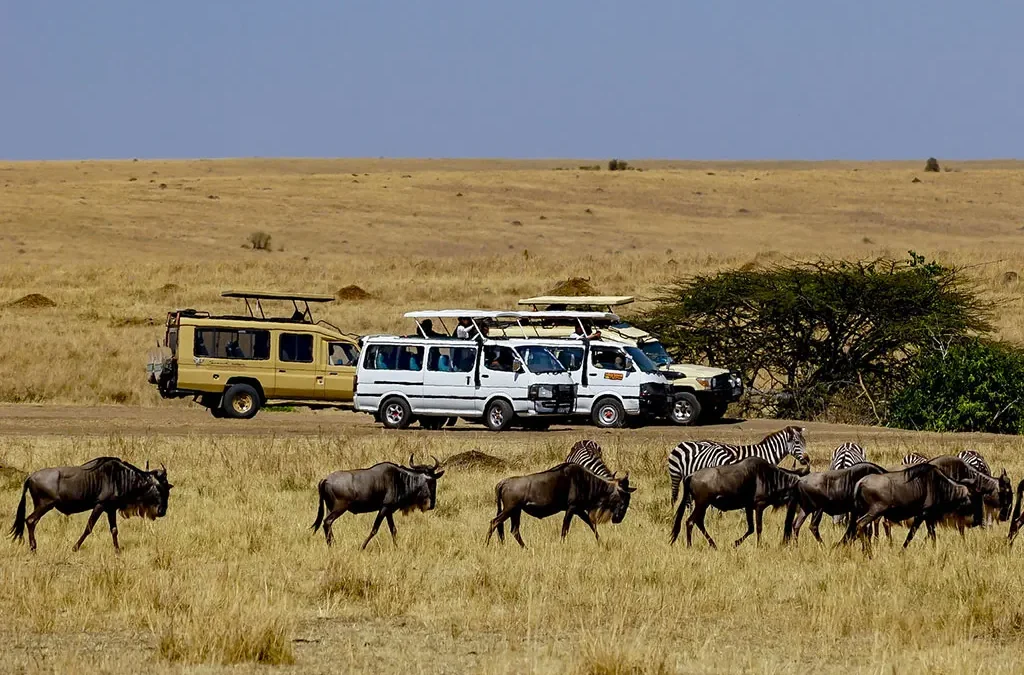
Kenya and Uganda Safari: Gorillas, Big Five & the Best Itineraries
A Kenya and Uganda safari pairs two very different kinds of wildlife travel in one trip: Kenya’s open savannah, with the Maasai Mara, Big Five game viewing and the Great Migration, and Uganda’s misty rainforests, where mountain gorillas and chimpanzees live alongside classic savannah parks. Together they cover what no single country can offer, and Nairobi and Entebbe are only a short flight apart.
We are Iconic Africa Safaris, a Uganda-based planner and tour operator, and this guide is how we advise our own guests: which itinerary length suits which traveller, what the trip really costs, how to move between countries, and when to go. Read it end to end, or jump to the section you need. Each section stands alone.
Quick Facts
- Ideal length: 10–14 days; seven is the practical minimum
- Core route: Nairobi, Maasai Mara, Entebbe, Bwindi
- Nairobi to Entebbe flight: roughly 1 hour 30 minutes
- Gorilla permit: USD 800 per person
- Peak months: June to October
- Shoulder bargains: March to May and November
- Trek group size: up to eight people per gorilla family
- Entry: Kenya eTA plus a Uganda e-visa, or the East Africa Tourist Visa
Why Combine Kenya and Uganda on One Safari?
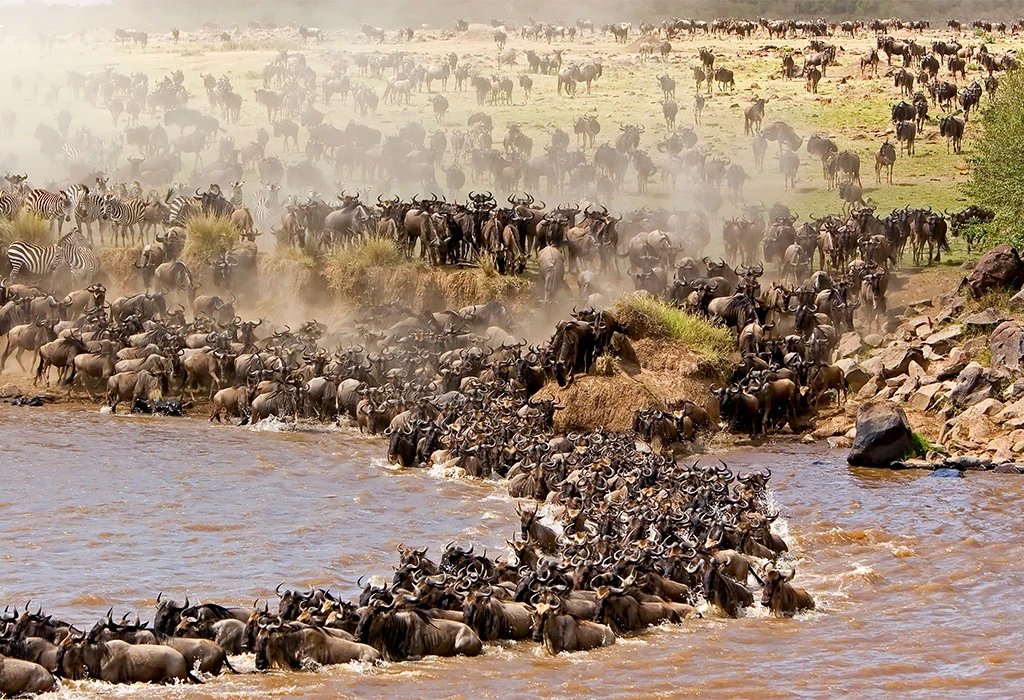
Thousands of wildebeest and zebra crossing the Mara River during the Great Migration in Kenya’s Maasai Mara
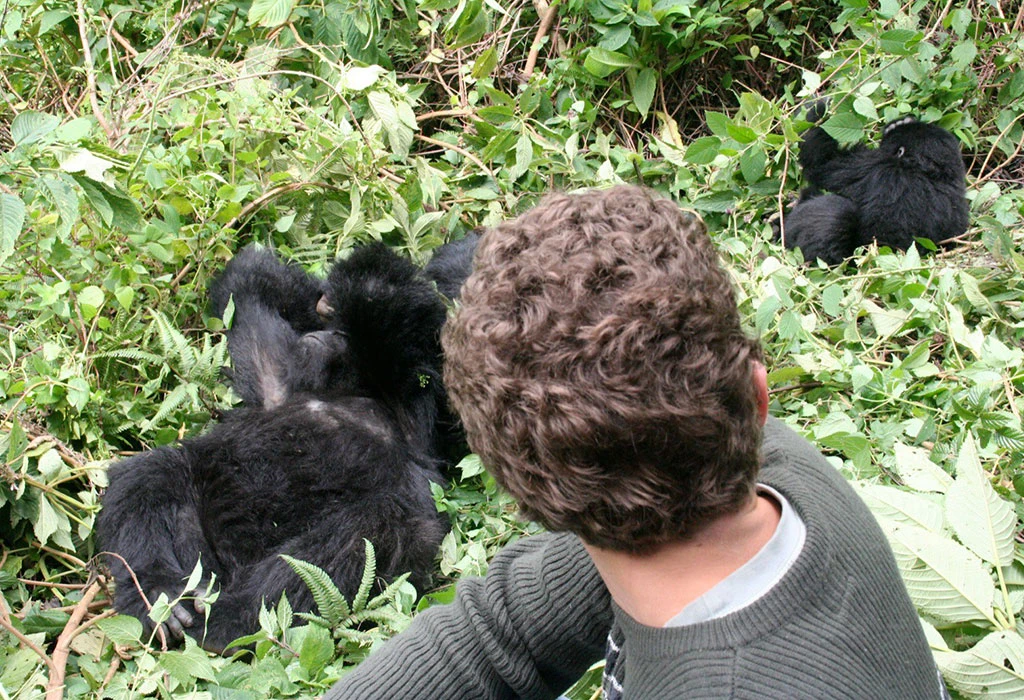
Just a few metres away, a visitor watches a mountain gorilla family relax in the forest. Every trek ends with one unforgettable hour among them
Kenya Offers the Classic African Safari
Kenya delivers the safari most people picture: golden grassland, acacia silhouettes and big predators on open plains. The Maasai Mara holds lions, leopards and cheetahs in strong numbers, plus elephants, buffalo and enormous herds of zebra and wildebeest. Private conservancies bordering the reserve add night drives and walking safaris, and visits to Maasai villages give the wildlife a living cultural context.
Uganda Adds Gorillas and Rainforest Wildlife
Uganda adds what Kenya cannot: close, quiet encounters with mountain gorillas in Bwindi’s ancient rainforest, and chimpanzee trekking in Kibale. Queen Elizabeth National Park brings tree-climbing lions, elephants and the hippo-lined Kazinga Channel, while Lake Bunyonyi offers calm after the trails. Uganda is greener, hillier and more intimate, and its terraced hills and crater lakes are worth the journey on their own.
Why the Two Countries Work So Well Together
The real value is contrast. Kenya’s plains reward long, patient game drives where you scan the horizon for movement; Uganda’s forests reward slow walking and close attention to sound and shadow. Each country makes the other feel fresh, so the trip never repeats itself. Logistics help too: Nairobi and Entebbe are well connected, and one planner can coordinate vehicles, permits and flights across both.
Best Kenya and Uganda Safari Itineraries
Length is the single decision that shapes everything else: how many parks you can enjoy, how much of the trip is spent in vehicles or airports, and what the journey costs. The matrix below summarises what each duration realistically delivers, and the sections that follow walk through every option so you can compare them honestly.
| Duration | Best for | Kenya | Uganda |
|---|---|---|---|
| 7 days | Short, focused trip | Maasai Mara | Bwindi gorillas |
| 9 days | First combination | Maasai Mara | Bwindi and Lake Bunyonyi |
| 10 days | Balanced and relaxed | Maasai Mara | Bwindi and Entebbe |
| 12 days | Most complete value | Maasai Mara | Kibale, Queen Elizabeth, Bwindi |
| 14 days | Wildlife enthusiasts | Ol Pejeta or Nakuru, Mara | Kibale, Queen Elizabeth, Bwindi, Bunyonyi |
| 15 days | Comprehensive | Several parks | Primates, savannah and Jinja |
7-Day Kenya and Uganda Safari
This is a focused combination, not the most relaxed one. You see the Mara and meet gorillas, but two of the seven days are largely transit and there is no slack if a flight is delayed. It suits travellers with limited leave who accept a brisk pace in exchange for both headline experiences.
- Day 1: Arrive in Nairobi and overnight in the city
- Day 2: Fly or drive to the Maasai Mara for an afternoon game drive
- Day 3: Full-day Mara safari with a picnic lunch
- Day 4: Return to Nairobi and connect to Entebbe
- Day 5: Fly or drive to Bwindi
- Day 6: Gorilla trekking, including an hour among the family
- Day 7: Return to Entebbe for your departure
Insider tip: Secure your gorilla permit before anything else. Permits are issued per sector and per date in limited numbers, and June to September and December sell out months ahead. Mara camps are far more flexible than permits, so we lock in the trek date first and build Kenya around it. If your date is gone, shifting the whole trip by a week is usually easier than finding another permit.
9-Day Kenya and Uganda Safari
Nine days is the combination we recommend most often to first-timers, because it adds two things the shorter plan lacks: breathing room and a day by the water. You keep the Maasai Mara and Bwindi as headline experiences, but gain a second full day in the Mara and a recovery stay on Lake Bunyonyi after gorilla trekking, when your legs will thank you.
- Day 1: Arrive in Nairobi
- Days 2–4: Maasai Mara, with two full game-drive days
- Day 5: Fly from Nairobi to Entebbe and overnight
- Day 6: Travel to Bwindi
- Day 7: Gorilla trekking
- Day 8: Canoeing and rest on Lake Bunyonyi
- Day 9: Return to Entebbe by air or road and depart
10-Day Kenya Uganda Gorilla Safari
Ten days gives you three advantages over the seven-day version: a buffer day before your gorilla trek, a second full day in the Mara, and a proper stop in Entebbe. Kenya takes four nights and Uganda five. If you want a Kenya Uganda gorilla safari that feels relaxed rather than rushed, this is where we steer guests who cannot spare two weeks.
Use the extra time well. Spend a half-day at the Entebbe Botanical Gardens or the Uganda Wildlife Education Centre on arrival, then add a night on Lake Bunyonyi before flying out. Both cost little, yet they turn transit hours into part of the experience rather than lost time between headline destinations.
12-Day Kenya and Uganda Safari
Twelve days is where the combination stops being a transit exercise and becomes a true East African journey. You get the Maasai Mara for Big Five viewing, then Uganda’s three signature experiences: chimpanzees at Kibale, lions and boat cruises at Queen Elizabeth, and gorillas at Bwindi. Driving days stay manageable, and every night is spent somewhere worth waking up.
- Days 1–4: Nairobi and the Maasai Mara, returning to Nairobi on day four
- Day 5: Fly to Entebbe
- Days 6–7: Drive to Kibale, track chimpanzees, continue to Queen Elizabeth
- Day 8: Game drive and Kazinga Channel boat cruise
- Days 9–10: Ishasha lions, then Bwindi and gorilla trekking
- Days 11–12: Return to Entebbe and depart
14-Day Kenya and Uganda Safari
Fourteen days brings Kenya’s highlands and Rift Valley into play: a first stop at Ol Pejeta or Lake Nakuru gives you rhinos before the Mara, and the Uganda leg is slowed enough to finish on Lake Bunyonyi. The route runs Nairobi, Ol Pejeta or Nakuru, the Mara, Entebbe, Kibale, Queen Elizabeth, Bwindi, Bunyonyi and Entebbe, with no driving day beyond five or six hours.
This is the itinerary we suggest to keen photographers and repeat safari-goers, because every ecosystem gets enough time for patient, unhurried viewing. It also builds in a genuine rest day after gorilla trekking, which most guests quietly appreciate once the adrenaline fades and tired legs remind them how steep the forest was.
15-Day Kenya and Uganda Safari
Fifteen days is for travellers who want the full picture: two or three Kenyan parks, the Maasai Mara, chimpanzees, savannah wildlife and gorillas in Uganda, and time for people as well as animals. Most guests add Jinja at the end, where the Nile leaves Lake Victoria, for white-water rafting or a gentler boat ride before flying home from Entebbe.
The extra day over the 14-day plan is best spent early in Uganda. A dawn boat trip into Mabamba Swamp near Entebbe offers one of Africa’s best chances of seeing the shoebill, an unmistakable, prehistoric-looking bird, and it fits neatly between your arrival from Nairobi and the long drive west.
Best Kenya and Uganda Safari Route
The route we recommend most often runs Nairobi, Maasai Mara, Nairobi, Entebbe, Kibale, Queen Elizabeth, Bwindi and back to Entebbe. It moves in a logical loop, avoids backtracking inside Uganda, and ends with the gorillas, which is the emotional high point of most trips. Shorter versions simply drop Kibale and Queen Elizabeth.
Kenya First, Uganda Second

Starting in Kenya is the norm for good reasons. The Mara is easy to reach and forgiving of small schedule changes, and finishing in Uganda leaves your fixed-date gorilla permit late enough that a delay earlier in the trip will not threaten it. Guests also enjoy ending on the quieter, more intimate note of the forest after the Mara’s drama.
Insider tip: Build a spare night between the Kenya and Uganda legs. Regional flights are occasionally retimed or cancelled, and a gorilla permit is tied to one date and rarely refundable. An extra evening in Entebbe, or a flexible first day in Bwindi, costs little compared with losing a permit worth USD 800.
Uganda First, Kenya Second

Reversing the order works well when Mara migration timing is your priority, or when you arrive in Entebbe and depart from Nairobi. It also lets you start with the slower, hill-walking pace and finish on open savannah. Remember that arriving in Kenya from Uganda means showing a yellow fever vaccination certificate, so keep it with your passport.
Kenya and Uganda Safari Map
The map traces the classic loop from Nairobi through the Mara, across to Entebbe and then west through Kibale, Queen Elizabeth and Bwindi. Use the approximate times below as planning figures, since traffic, weather and flight schedules all move them, and remember that on winding Ugandan hill roads, hours matter far more than kilometres.
| Leg | Typical transfer |
|---|---|
| Nairobi to Maasai Mara | 5–6 hours by road, about 45 minutes by air |
| Nairobi to Entebbe | About 1 hour 30 minutes by air |
| Entebbe to Kibale | 5–6 hours by road |
| Kibale to Queen Elizabeth | 2–3 hours by road |
| Queen Elizabeth (Ishasha) to Bwindi | 2–3 hours by road |
| Bwindi to Entebbe | About 1.5 hours by air, 8–10 hours by road |
Kenya Uganda Safari Cost
Costs vary widely, but the structure is predictable: park fees, a gorilla permit, accommodation and transport make up nearly everything. The figures below are indicative per-person prices for a 10-day itinerary, two people sharing, excluding international flights. Your final quote depends on season, lodge choice and group size, so treat these as a planning range rather than a promise.
| Safari style | Indicative cost per person | Typical stay |
|---|---|---|
| Budget | USD 4,500–5,800 | Simple lodges and tented camps |
| Mid-range | USD 6,500–9,000 | Comfortable lodges, private vehicle |
| Luxury | USD 11,000–16,000 | Boutique camps and conservancies |
| High-end | USD 18,000+ | Exclusive private camps, fly-in transfers |
Gorilla and Chimpanzee Permits
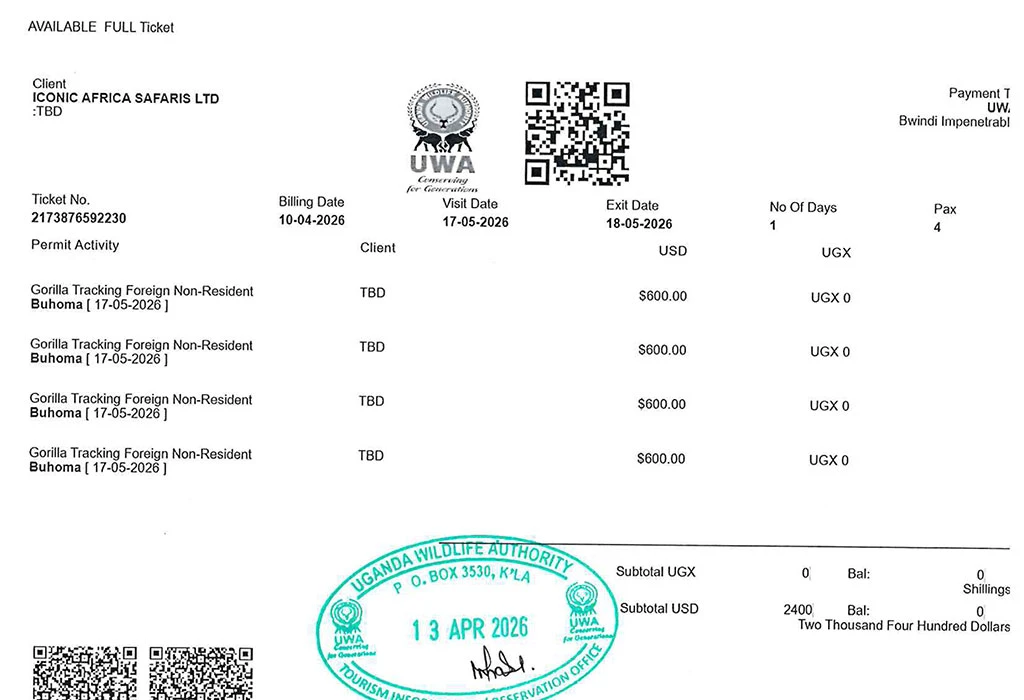
One of our May 2026 discounted gorilla permits — which were reserved for an Iconic Africa Safaris clients.
The gorilla permit is the largest single fixed cost: USD 800 per person per trek for foreign non-residents. It carries no discount, whichever sector you choose. Chimpanzee tracking in Kibale costs around USD 250, and the longer habituation experience costs considerably more. Permits are paid in advance and generally non-refundable, so travel insurance that covers cancellation is well worth having.
Park and Conservancy Fees
Kenya’s fees are high and rise in peak season. The Mara’s daily entry charge for non-residents ranges from roughly USD 100 to 200 per person depending on the month, and conservancy camps add their own fee in exchange for fewer vehicles. Uganda’s savannah parks charge about USD 40 to 50 per day, so most of your Uganda budget goes to permits and lodging.
Accommodation
Lodging is the biggest lever you control. Tented camps in the Mara range from simple to extravagant, and Bwindi’s forest lodges vary by sector as much as by star rating. Staying at the edge of a park saves transfer time but can cost more, so we balance both by choosing rooms close to your trek start or game-drive area.
Vehicle, Driver-Guide and Flights
The private 4×4 and driver-guide are costed per day, and we use a separate vehicle in each country. Scheduled flights add convenience: Mara flights run roughly USD 150 to 250 each way, and Entebbe to the Bwindi airstrips typically USD 250 to 400 each way. International flights are separate and often the largest unknown in the final budget.
Number of Travellers and Season
Costs per person fall as numbers rise, because vehicles and guides are shared, while solo travellers pay a single supplement. Season matters just as much: June to October commands the highest lodge rates, while March to May and November bring meaningful reductions. The gorilla permit price, however, never changes with the calendar.
Private vs Group Safari
A private safari costs more per person but gives you control of pace, dates and vehicle, which matters on a trip where permit dates, flights and weather interact. Group departures cut prices, though dates are fixed and you travel with strangers. We build private itineraries because flexibility is hard to buy back once a permit and flight schedule are locked.
What Is Included in a Kenya Uganda Safari Package?
- Accommodation in lodges and camps as listed in your itinerary
- Meals, typically full board on safari
- Private 4×4 safari vehicle with pop-up roof
- Professional English-speaking driver-guide
- Park and conservancy entrance fees
- Gorilla permit, and chimpanzee permit where the itinerary includes it
- Airport transfers in both countries
- Bottled drinking water
- Game drives and boat cruises as scheduled
What Is Not Included?
- International flights to and from East Africa
- Visa, eTA and vaccination costs
- Travel and medical evacuation insurance
- Tips for drivers, guides, rangers and lodge staff
- Alcohol, drinks outside meals and laundry
- Optional extras such as balloon flights and rafting
- Porters for gorilla and chimpanzee treks
- Personal shopping and souvenirs
Kenya vs Uganda Safari: Which Is Better?
Plenty of travellers searching for a combination safari have not yet decided whether to visit both countries, and that is a fair question. The table compares them honestly, including the places where Uganda does not match Kenya. Neither country is better overall; they are simply better at different things.
| Feature | Kenya | Uganda |
|---|---|---|
| Big Five | All five, in the Mara region and conservancies | Four in the wild; rhinos at Ziwa sanctuary |
| Mountain gorillas | None | Bwindi and Mgahinga |
| Chimpanzees | Sanctuary only, at Ol Pejeta | Wild trekking in Kibale and beyond |
| Great Migration | Yes, July to October | No |
| Open savannah | Excellent | Good |
| Rainforest | Limited | Excellent |
| Primates overall | Good | Exceptional |
| Safari style | Classic, vehicle-based | Mixed: vehicle, boat and foot |
| Crowds | Busier in the Mara at peak | Generally quieter |
When to Choose Kenya Only
Choose Kenya if the Great Migration, vast open plains and consistent big cat sightings are your priority, or if you have only five or six days. Kenya also suits first-timers who want classic safari comfort, straightforward logistics and the widest choice of lodges and camps in a single destination.
When to Choose Uganda Only
Choose Uganda if gorillas and chimpanzees top your list, if you prefer quieter parks with fewer vehicles, or if you enjoy varied activities such as forest walks, boat cruises and crater-lake scenery. Uganda also rewards travellers who value smaller lodges and personal guiding over scale, though roads and longer drives demand patience.
When to Choose Both Uganda and Kenya
Choose both if you have ten days or more and want a safari that never feels repetitive: savannah drama in Kenya, then intimate primate encounters in Uganda. It also makes sense when you want to see the Big Five and mountain gorillas on a single itinerary, which neither country delivers alone.
Kenya and Uganda Safari Highlights
Kenya
- Maasai Mara: Kenya’s great predator stage, with big cats year-round, Mara River crossings in season and a ring of private conservancies
- Lake Nakuru: a compact Rift Valley park protecting both white and black rhino, with flamingo flocks that shift with water levels
- Ol Pejeta Conservancy: home to the last two northern white rhinos and a chimpanzee sanctuary
- Nairobi: giraffe feeding, an elephant orphanage and a national park minutes from the skyline
Uganda
- Bwindi Impenetrable Forest: a UNESCO site holding close to half the world’s mountain gorillas, split among four trekking sectors
- Kibale Forest: the best place in East Africa for chimpanzees, with a dozen other primate species
- Queen Elizabeth National Park: tree-climbing lions, elephants, crater lakes and the hippo-packed Kazinga Channel
- Lake Bunyonyi: terraced hills, canoeing and calm, with swimming considered safe from bilharzia
- Entebbe: the Lake Victoria shoreline, botanical gardens and shoebill boat trips
Insider tip: Split your Mara stay between two settings. Spend two nights in a private conservancy for night drives, walking safaris and limited vehicle numbers at each sighting, then one or two on the reserve side if river crossings matter to you. Few guests realise the two can be combined, and doing so adds little cost while giving you the best of both.
Wildlife You Can See on a Kenya Uganda Safari
Kenya
- Big cats: lion, leopard and cheetah, all regularly seen in the Mara
- Big herbivores: elephant, buffalo, black and white rhino, hippo and giraffe
- Plains game: zebra, wildebeest, topi, impala, eland and Thomson’s gazelle
- Smaller predators: spotted hyena, jackal, serval and bat-eared fox
- Birds: ostrich, secretary bird, lilac-breasted roller and, seasonally, Nakuru’s flamingos
Uganda
- Primates: mountain gorilla, chimpanzee, black-and-white colobus, red-tailed monkey and L’Hoest’s monkey
- Savannah wildlife: elephant, buffalo, hippo, leopard and lions, including Ishasha’s tree-climbers
- Antelope: Uganda kob, topi, waterbuck and bushbuck, with warthogs almost everywhere
- Birds: more than a thousand species nationwide, including the shoebill
- Boat-trip stars: Nile crocodiles and enormous hippo pods
Wildlife is wild, and no honest operator can promise a particular sighting. Leopards are secretive, gorilla families sometimes move far overnight, and rain can scatter animals. What we can do is raise your odds: experienced guides, enough time at each location, and early starts, when predators are active and the light is best for photography.
Kenya Uganda Gorilla Safari
Gorilla trekking is the emotional centre of most Kenya and Uganda combinations, and it deserves careful planning. These gentle giants live only in the forests of Uganda, Rwanda and the Democratic Republic of Congo, and encounters in Uganda tend to be close, quiet and refreshingly uncrowded, with small groups and a strict one-hour limit once you reach the family.
Where Do You Trek Gorillas in Uganda, and Bwindi vs Mgahinga
Most guests trek in Bwindi, which has around twenty habituated families spread across four sectors: Buhoma, Ruhija, Rushaga and Nkuringo. Mgahinga, a small park in the Virunga volcanoes, has a single habituated group that sometimes wanders across the border, making sightings less certain. For reliability and choice of permits, Bwindi is the clear recommendation.
How Difficult and How Long Is Gorilla Trekking?
Difficulty depends on where your assigned family spent the night. Treks can last from under an hour to most of a day, through steep, muddy, humid forest at altitudes between roughly 1,500 and 2,600 metres. Once you find the gorillas, you stay with them for one hour. Porters, available for a modest fee, make the climb far easier.
Insider tip: Be honest about your fitness when we book. Rangers assign visitors to gorilla families on the morning of the trek according to ability, and we can ask in advance for a sector with shorter, gentler routes. Hire a porter even if you are fit: they carry your daypack, steady you on slippery slopes, and the income supports households around the forest.
What Is the Gorilla Permit?
Permits are issued by the Uganda Wildlife Authority for one family on one date, in your name. The minimum age is 15, and anyone with a cold or flu-like illness may be refused to protect the gorillas. We handle the booking for our guests, but we need passport details early, because a permit cannot be transferred to another person once it has been issued.
What Should You Pack for Gorilla Trekking?
- Waterproof hiking boots with ankle support and good grip
- Long trousers tucked into socks or gaiters to keep out ants
- A long-sleeved shirt and waterproof jacket, even in the dry season
- Light gardening gloves for gripping vines and avoiding nettles
- Insect repellent, a daypack and at least two litres of water
- A walking stick, which rangers provide, and a face mask for close contact
Kenya and Uganda Safari With Chimpanzee Trekking
Kibale Forest National Park, near Fort Portal, holds one of the highest primate densities in Africa, and its habituated chimpanzee communities are tracked twice daily. Sessions begin at 8am and 2pm, and you get an hour with the chimps once they are found. Expect noise, sprinting and treetop feeding rather than the quiet stillness of gorillas.
Chimpanzee Trekking vs Gorilla Trekking
Gorillas are calm and mostly ground-dwelling, so encounters feel contemplative. Chimpanzees are fast, loud and often high in the canopy, so the experience is energetic and you may spend much of it looking upward. Chimp treks are usually shorter, more predictable and cheaper, and the minimum age is 12 rather than 15.
Can You Combine Gorillas and Chimpanzees?
Yes, and we recommend it. Kibale sits naturally between Entebbe and Queen Elizabeth on the way to Bwindi, so adding chimpanzees costs roughly one extra day. Travellers who want more can visit Kyambura Gorge in Queen Elizabeth, a forested chasm where a small chimp community lives, as a quieter alternative.
Best Itinerary for Gorillas, Chimps and Maasai Mara
The 12-day route is the best fit: three days in the Mara, a full Kibale morning, a night or two at Queen Elizabeth, and two nights in Bwindi. If you have fewer days, drop Queen Elizabeth first and keep Kibale, because the chimps add more variety to the trip than a second savannah park.
Insider tip: Book the morning chimpanzee session. The chimps are most active and vocal after waking, and finishing by late morning leaves your afternoon free for the Bigodi Wetland Sanctuary, a community-run walk with excellent monkeys and birdlife. The afternoon session is hotter, quicker to tire you, and often leaves you arriving at your next lodge after dark.
Best Time for a Kenya and Uganda Safari
There is no single best month, because two climates and two wildlife calendars overlap across both countries. The safest planning rule is to decide your priority, the migration or the gorillas, then check what each season does to comfort, price and availability. Here is how the year breaks down.
- June to September: Dry in both countries, with firmer trails, migration herds in the Mara and peak prices
- October to November: Migration lingers into October, then short rains turn Kenya green and Uganda muddy, with fewer visitors
- December to February: Warm, mostly dry weather suits trekking and Mara wildlife, though Christmas weeks are busy
- March to May: Heavy rains make trails slippery and some camps close, but rates drop sharply and crowds disappear
Why does this matter? Dry-season forests are firmer underfoot and easier to climb, yet gorillas can be found in any month because they feed year-round. Wet-season trekking is harder but quieter, and permits are easier to secure. The true constraint is your Mara timing, which is far more seasonal than the primates.
Kenya Uganda Safari During the Great Migration
The Great Migration is a Serengeti-Mara ecosystem event involving well over a million wildebeest and hundreds of thousands of zebra and gazelle. They usually enter the Maasai Mara from July, with the dramatic Mara River crossings peaking in August and September. By late October most herds begin drifting back south as the rains return.
The important distinction is that the migration and gorilla trekking follow different seasonal logic. Herds move with grass and rain; gorillas stay in their forest all year. Combining the two means July to September for the Mara, which is also the busiest trekking window, so demand for both runs high at the same moment.
If you travel outside those months, do not write the Mara off. Resident wildlife, including lion prides, cheetahs and elephants, is excellent throughout the year, and fewer vehicles mean more peaceful sightings. Simply set your expectations accordingly: river crossings are a bonus in the right season, never a guarantee.
Where to Stay on a Kenya Uganda Safari
Kenya
- Nairobi: quiet hotels in Karen or Westlands, close to the airport, the giraffe centre and the elephant orphanage
- Maasai Mara: tented camps, from simple to luxurious, inside the reserve or in the private conservancies
- Lake Nakuru and Ol Pejeta: lodges and camps with rhino views, plus guided night drives at Ol Pejeta
Uganda
- Entebbe: lakeside guesthouses and hotels minutes from the airport
- Kibale: forest-edge lodges and crater-lake camps around Fort Portal
- Queen Elizabeth: lodges overlooking the Kazinga Channel, or near Ishasha for the tree-climbing lions
- Bwindi: sector-based lodges, from small ecolodges to luxury camps with valley views
- Lake Bunyonyi: island and lakeshore lodges, ideal for recovering after trekking
Accommodation falls into four broad tiers. Budget means basic lodges and simple tented camps; mid-range gives comfortable rooms and good food; luxury adds boutique camps with private guiding; high-end covers exclusive, often fly-in properties. We choose by location first, because a lodge close to your trek start or game-drive area saves hours.
How to Travel From Kenya to Uganda
Nairobi to Entebbe by Air
Flying from Nairobi to Entebbe takes about an hour and a half, with several daily flights on regional carriers including Kenya Airways and Uganda Airlines. It is the option we use for almost every itinerary because it turns a two-day border crossing into a comfortable morning. Keep layovers generous when connecting from the Mara.
Nairobi to Uganda by Road
Driving from Nairobi to Kampala covers roughly 650 kilometres via Naivasha, Nakuru and Eldoret to the Malaba or Busia border, and takes 12 to 14 hours plus crossing time, usually split over two days. The scenery is rewarding for overland enthusiasts and budget travellers, but it consumes days that most itineraries cannot spare.
Entebbe to Bwindi and Domestic Flights in Uganda
From Entebbe, Bwindi is a drive of eight to ten hours, passing the equator and the hills around Kabale. Small scheduled planes fly to Kihihi, for Buhoma and the northern sectors, or Kisoro, for Rushaga and Nkuringo, in around ninety minutes, with baggage limited to roughly 15 to 20 kilograms in soft bags.
Should You Drive or Fly?
On trips shorter than twelve days, fly; time is your scarcest resource. On longer trips, we suggest flying one way and driving the other. The drive from Queen Elizabeth to Bwindi through Ishasha is one of Uganda’s loveliest, and combining the two modes gives you the scenery without losing a second full day.
Insider tip: When transferring from Queen Elizabeth to Bwindi, leave early enough to reach Ishasha by mid-morning. Tree-climbing lions are most often found dozing in fig trees in the cooler morning hours, and the sector sees far fewer vehicles than the northern part of the park. Done well, a transfer day becomes a bonus game drive.
Kenya Uganda Safari Visa and Border Requirements
Entry rules change, so treat this section as a guide and confirm details before booking flights. Last updated: October 2026. Kenya currently requires most visitors to obtain an electronic travel authorisation online before departure, while Uganda issues e-visas for most nationalities through its immigration portal, at about USD 50 for a single entry.
Travellers visiting both countries often prefer the East Africa Tourist Visa, priced at USD 100, valid for 90 days and covering Kenya, Uganda and Rwanda. Its procedures have changed more than once, so we verify them for every guest. Passports should be valid for six months with blank pages. Uganda currently doesn’t require yellow fever vaccination proof on arrival, but Kenya some times asks for it.
What to Pack for a Kenya and Uganda Safari
- Safari clothing: neutral khaki, olive and tan layers, plus a warm fleece for dawn drives
- Documents: passport, visa papers, vaccination certificate and insurance details
- Electronics: camera, spare batteries, a power bank and a Type G adapter, as both countries use UK-style sockets
- Health and personal items: prescription medicine, sunscreen, repellent and a basic first-aid kit
- Rain protection: a light waterproof jacket and a dry bag for electronics
- Photography: binoculars and a zoom lens of at least 200 mm
Insider tip: Pack in soft duffel bags weighing no more than 15 kilograms, including hand luggage. Light aircraft to the Mara and Bwindi enforce strict baggage limits and cannot load hard suitcases, and an overweight bag can be left behind. Leave surplus luggage safely at your Nairobi or Entebbe hotel, where it will wait for your return.
Kenya Uganda Safari for Different Travellers
- Couples: Private vehicle, bush sundowners and unhurried mornings
- Honeymooners: Balloon flights, bush dinners and a quiet night on Lake Bunyonyi
- Families: Kenya suits any age; gorilla trekking requires 15 and chimpanzee tracking 12
- Solo travellers: A private guide sets the pace, with company on every trek
- Friends and groups: Shared vehicles reduce costs; eight people can fill one gorilla permit group
- Luxury travellers: Fly-in camps, private guiding and carefully chosen trek sectors
- First-timers: Start with ten days; it is the gentlest way to try both countries
Is a Kenya and Uganda Safari Worth It?
Yes, if you want contrasting wildlife experiences and can give the trip at least a week. Few journeys deliver both a savannah predator spectacle and an hour among wild gorillas, and the contrast makes each feel richer. Guests who commit ten days or more almost always tell us they would not trade either country.
No, if you only have four or five days. Cramming two countries into that window means more time in airports than in parks, and you would be better served by a short Kenya safari or a short Uganda gorilla trip. We would rather tell you that than sell you a longer package than you need.
Kenya Uganda Safari Frequently Asked Questions
What is the best Kenya and Uganda safari itinerary?
For most travellers, the 12-day route through Nairobi, the Maasai Mara, Entebbe, Kibale, Queen Elizabeth and Bwindi gives the best balance of wildlife, comfort and value. If you have less time, a 10-day plan that skips Kibale and Queen Elizabeth works well. Add days at either end only if you want slower pacing, not more locations.
How many days do I need for Kenya and Uganda?
Seven days is the minimum that works, though it is rushed, with two days largely spent in transit. Ten days is the point at which the trip becomes comfortable, and twelve to fourteen days allow chimpanzees, Queen Elizabeth and a proper rest day. Beyond fifteen days, extra time is better spent on depth than on additional stops.
How much does a Kenya Uganda safari cost?
There is no single price, because style, season and group size all move it. Three line items shape most of the total: the gorilla permit, Mara fees and your lodging tier. Share your dates and preferences and we will send an itemised quote showing exactly where your money goes, so you can adjust before committing.
Can I combine a Kenya safari with gorilla trekking?
Yes. A short flight links Nairobi and Entebbe, and from there Bwindi is a day’s drive or a ninety-minute flight away. The key is to secure your permit date first and then plan Kenya around it. Many travellers pair the Maasai Mara with Bwindi in as little as seven days, though ten is kinder.
How do I travel from Kenya to Uganda?
Most guests fly from Nairobi to Entebbe in about ninety minutes on one of the regional carriers. The alternative is a road journey to Kampala of twelve to fourteen hours plus border formalities, which suits overland travellers but uses up valuable days. We arrange transfers on both sides so you are met at every airport.
Is Kenya or Uganda better for safari?
Neither is better; they excel at different things. Kenya wins for vast plains, the migration and reliable predator viewing, while Uganda wins for primates, forests and quiet. If you can choose only one, pick Kenya for a classic safari or Uganda for gorillas. If you can spare ten days, choose both.
Can I see the Big Five in Kenya and Uganda?
In Kenya, yes: lion, leopard, elephant, buffalo and rhino all occur around the Mara, Lake Nakuru and Ol Pejeta, though leopards and rhinos need patience. In Uganda, rhinos live only at Ziwa Rhino Sanctuary, so the other four are found in the wild parks. Most guests complete the full set in Kenya.
Where do I trek gorillas in Uganda?
Gorilla trekking in Uganda takes place in Bwindi Impenetrable Forest and Mgahinga Gorilla National Park. Bwindi has four sectors and many families, so it is the more dependable choice. Gorillas also live in Rwanda and the Democratic Republic of Congo, but Uganda combines availability, a lower permit price and superb scenery, which suits a Kenya combination.
Is gorilla trekking safe?
Yes, with sensible precautions. Armed rangers accompany every group, and the gorillas have been habituated to people over years. Follow the briefing: keep seven metres back, stay quiet and never approach. The real risks are slippery trails and illness, which is why rangers screen visitors and ask anyone unwell to stay behind.
What is the best time for a Kenya Uganda safari?
Choose June to September for the migration and driest trails, December to February for warm weather and fewer crowds, and March to May or November for lower prices and green landscapes. If the migration matters most, plan your Kenya leg for August or September and let the rest of the trip follow from there.
Can I see the Great Migration and gorillas on one trip?
Yes, and it is a popular pairing for July to September travel. Because both experiences are in high demand then, book the permit and your Mara camp six to nine months ahead. Plan the Mara first and end in the forest, so that any flight disruption leaves your trek date intact.
Can I combine Kenya, Uganda and Tanzania?
Yes, though it needs at least sixteen days to avoid constant movement. The easiest sequence is Uganda, Kenya and then Tanzania, linking by flights or a Nairobi to Arusha road transfer, and ending in the Serengeti and Ngorongoro. We build these multi-country journeys on request and can show you how to join the three without repeating experiences.
Kenya Uganda Safari Packages
Every package below is a starting point, never a fixed product. We adjust hotels, vehicles, permit dates and pace to match your preferences, and each has its own page with a day-by-day description. Choose the nearest match and we will tailor it around your dates, fitness and budget.
| Package | Route | Best for |
|---|---|---|
| 7-Day Kenya & Uganda Gorilla Safari | Maasai Mara and Bwindi | Short, focused trips |
| 9-Day Kenya & Uganda Safari | Maasai Mara, Bwindi and Lake Bunyonyi | First-time combinations |
| 10-Day Kenya Uganda Gorilla Safari | Maasai Mara, Bwindi and Entebbe | Relaxed pacing |
| 12-Day Kenya Uganda Wildlife & Gorilla Safari | Mara, Kibale, Queen Elizabeth and Bwindi | Most travellers |
| 14-Day Kenya & Uganda Safari | Kenya wildlife and four Uganda parks | Wildlife lovers |
| 15-Day Kenya Uganda Ultimate Safari | Several parks, chimpanzees and gorillas | The complete picture |
Why Book a Kenya Uganda Safari With Iconic Africa Safaris?
We are based in Uganda, so the hardest parts of this trip, gorilla permits, Bwindi logistics and road conditions, are handled by people who work with them every week. We then coordinate the Kenyan leg with trusted local partners, so you deal with one planner from your first enquiry to your departure.
- Gorilla and chimpanzee permit booking, with date changes handled where the rules allow
- Private 4×4 vehicles with experienced driver-guides
- Lodges and camps matched carefully to your budget in both countries
- Domestic and regional flights arranged and monitored
- Airport meet-and-greet in Nairobi and Entebbe
- Itineraries tailored to your pace, interests and fitness
- Support before and throughout your safari
Ready to Plan Your Kenya and Uganda Safari?
Iconic Africa Safaris offers three simple, reliable ways to secure your next unforgettable Kenya and Uganda Safari today. Simply complete our quick online booking form to start planning your dream safari experience right away. Our friendly team also welcomes direct emails at info@iconicafricasafaris.com to discuss your specific travel plans and preferences. For WhatsApp messages and calls, tap the green WhatsApp icon in your screen’s bottom right corner anytime.
Our driver-guides are the trip managers guests trust most — trained professionals, all skilled interpreters of wildlife and culture. They stay with travelers from the first airport pickup to the final wave-off, keeping each day running smoothly and safely.