
How to Book Gorilla Habituation in Bwindi
Are you planning a safari that gives you a full morning beside wild mountain gorillas instead of a rushed single hour? Gorilla habituation in Bwindi forest answers exactly that wish. Deep in the southern hills of Uganda, inside the Rushaga sector of Bwindi Impenetrable National Park, a handful of visitors each day join researchers and trackers as they slowly teach two wild gorilla families to trust people. You get up to four hours with these primates, far longer than a standard trek allows. The walk is tough, the forest is steep and wet, and the reward is rare. Below, you’ll find what the experience involves, how a habituation day unfolds hour by hour, where to sleep in Rushaga, how to reach the park, and why so many travelers book this trip with us.
What Does Gorilla Habituation in Bwindi Involve?
Gorilla habituation happens only in the Rushaga sector, the southern part of Bwindi where two semi-habituated families live: Bikingi and Bukungu (also spelled Bukinga). Rangers formed the Bikingi group after the Mishaya family split apart, while Bukungu is a newer family still learning to feel calm around humans. Here’s what sets the experience apart:
- Time with the gorillas: You spend up to four hours beside them, compared with just one hour on a normal trek. That extra time changes everything.
- Permit cost: A permit currently is at $1,800 per person from $1,500 for foreign non-residents and $1,500 from $1,000 for foreign residents.
- Group size: Only 4 visitors join a family each day, so your group stays small and quiet.
- Who can go: You must be at least 15 years old and in good health, since gorillas catch human illnesses easily.
Before dawn — around 5:00 am
You wake in the dark, and the cold hits you first. Rushaga sits high in the southern hills of Bwindi, so the air feels thin and damp at that hour, often near 11°C, with mist still pooling in the valleys below your lodge. A hot breakfast waits – eggs, toast, fruit, and plenty of coffee or tea. Most lodges pack a lunch box and fill a flask, because you won’t see food again for many hours. Now you run your final kit check: long trousers tucked into socks, long sleeves, broken-in waterproof boots, gaiters, a rain jacket whatever the sky looks like, garden gloves for grabbing nettles and vines, insect repellent, and at least two litres of water. Bring a camera with a zoom lens; it earns its place far more than a phone.
6:00 am – briefing at the Rushaga ranger post
You drive the short distance to the Uganda Wildlife Authority briefing point at Rushaga. A standard one-hour trek can pack 8 people around one family, but the habituation experience stays deliberately tiny – only 4 visitors join a single family for the whole day, so the group around you feels calm.
At registration you hand over your passport photocopy, habituation permit and payment receipts. Payment must be cleared in advance through a licensed operator such as Iconic Africa Safaris, because the gate no longer takes cash.
Next, the head ranger runs the safety briefing:
- Keep your distance: Stay 7–10 metres back, wear a mask when you’re close, and use no flash.
- Protect the gorillas: Don’t eat or drink near them, turn away to cough or sneeze and never trek while sick, since they share enough of our DNA to catch our diseases.
Here the habituation day differs from a normal trek. You meet a ranger-guide, armed escort, researchers but also trackers who follow this semi-habituated family every day, so you join their real conservation work rather than simply visiting. On some mornings a local community group welcomes you with drumming and dance while you wait. This is also your chance to hire a porter for roughly USD 15–20 — take one. They carry your bag, pull you up the steep parts, and the money flows straight into the surrounding community.
6:30 am – entering the forest
The trackers usually set out ahead of you, radioing back from the spot where the family nested the night before. You step off the trailhead, and the word “Impenetrable” stops sounding poetic. Terrain in the south genuinely tests you — steep ridges drop into valleys and climb straight back out, vines tangle underfoot, mud sucks at your boots, and the humidity has you sweating within minutes despite the cold start.
Because these families are only semi-habituated, they roam farther and move less predictably than fully habituated groups, so these treks usually cover more ground and last longer. Reaching them can take anywhere from one hour to four or more. Along the way, the forest hums with life: turacos and other birds call overhead, monkeys crash through the canopy, butterflies flash past, and columns of safari ants march across the path. Your guide reads the forest the whole time, staying in radio contact with the trackers and closing in.
The encounter – up to 4 hours
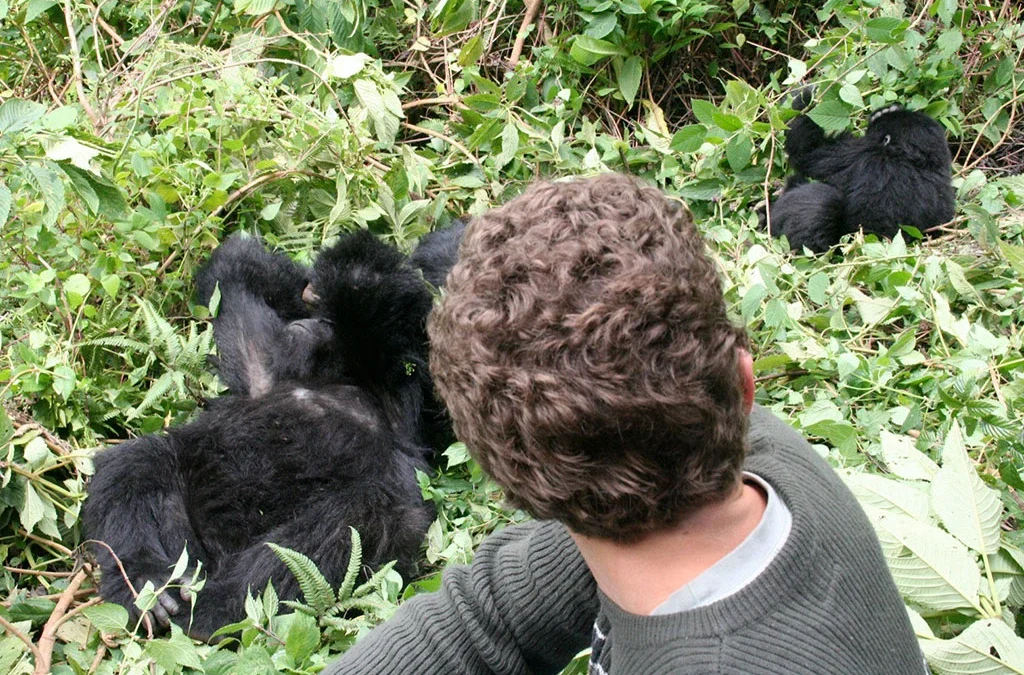
Then the trackers signal that the family is close. You drop your daypack with the porter, pull on your mask, and push the last few metres through the leaves – and there they are. These gorillas are still learning that humans mean no harm, so they act differently -more alert, sometimes wary. A juvenile beats its chest in a bluff, the silverback turns to size you up, and the family keeps shifting. You watch them react, challenge, settle, and slowly ignore you, while the researchers quietly explain each sound and gesture: the soft “naoom” content-grumbles, the chest-beats, the feeding, the grooming, and the infants tumbling over the patient adults.
Four hours sounds long until you’re living it. People who do both the standard trek and the habituation almost always say the extra time is what finally lets you stop fumbling with your camera and simply be present – to notice individual personalities, sit with the silverback’s calm, and feel the forest close around the whole scene. You move with the family as they feed, always holding your distance while the researchers manage the contact.
Finishing – early to mid afternoon
When your time runs out, you ease back, give the family room, and start the hike out — which, across Rushaga’s terrain, often means a long uphill grind back to the ridge. Here the porter truly earns the fee. Back at the trailhead, the rangers award you a certificate recording your habituation experience, usually handed over with real warmth by the team who spent the day with you.
By the time you reach the lodge, the afternoon has usually arrived. You’re muddy, soaked somewhere, tired, and quietly buzzing. A hot lunch waits, along with the simple joy of peeling off your boots. Most people then sink into a chair and replay the morning in their heads. After a hot shower and a drink on the deck, looking back over the hills you climbed, you’ll want an early night — because your legs will remind you of all of it tomorrow.
Where Should You Stay in Rushaga?
Rushaga offers lodges for every budget, and most sit close to the briefing point. Here are the standouts in each tier.
Budget Lodges:
- Nshongi Camp: The best-value pick. It sits right on the forest edge above a swampy clearing, so colobus, duikers, and even a sitatunga wander into view from the dining terrace. The briefing point is about a 5-minute walk away.
- Rushaga Gorilla Havens Lodge: Rooms stay basic, yet guests single it out for arguably the best forest view of any budget lodge here. It’s roadside and easy to reach, though a few visitors reported theft, so lock your valuables.
- Bwindi Breeze Lodge: A small, newer B&B in Rubuguri. Quiet and simple, it makes a solid fallback when the others fill up.
Mid-Range Lodges:
- Bweza Gorilla Lodge: The standout in this tier. Perched on a hilltop, it offers big modern rooms with private terraces and an outdoor fireplace for jungle-sound evenings, so it punches well above its price. Note it sits slightly farther out if you end up trekking from Nkuringo.
- Ichumbi Gorilla Lodge: Reliable cottages with private balconies, strong hot showers, restaurant WiFi, and service guests rave about. The gate is roughly 10 minutes away.
- Rushaga Gorilla Lodge: The big, popular all-rounder, complete with a pool and even a helipad. Quality varies, so request the cottages or luxury tents rather than the weaker standard rooms.
- Gorilla Valley Lodge: Gorillas sometimes wander through the garden, and the forest views impress. Rain turns the access road to mud, so bring a 4×4.
Luxury Lodges:
- Gorilla Safari Lodge: The classic luxury name in Rushaga, with 19 bungalows, fireplaces, a spa, and the trailhead within walking distance. Service feels polished and attentive.
- Gorilla Leisure Lodge: Beautiful polished-wood suites with African decor, candlelit dinners, a hand massage on arrival, and lovely valley views — all just minutes from the gate.
- Four Gorillas Lodge: “Affordable luxury” and a honeymoon favorite. Guests have spotted gorillas from the lodge itself, and it’s among the closest to park HQ, about 10 minutes away.
- Gorilla Hills Eco-Lodge: Spacious near-new rooms with large private balconies and what reviewers call the best breakfast around. The access road is bumpy, so a 4×4 is essential.
How Do You Book Gorilla Habituation in Bwindi?
Booking with us is simple. Reach out through the booking form, email info@iconicafricasafaris.com, or tap the WhatsApp button in the bottom-right corner of your screen for an instant chat. Tell us your travel dates, the number of people in your private group, your preferred accommodation level (Budget, Mid-Range, or Luxury), and how many days you’d like to travel. From there, one of our local consultants builds a personalized, fully costed itinerary around your wishes. Maybe you want habituation alone, or maybe you’d like to add a game drive in Queen Elizabeth National Park or chimpanzee tracking in Kibale – either way, we’re one message away, 24 hours a day.
One more thing worth knowing: Habituation permits are limited and sell out fast. So if you plan to travel during peak season, book 3–6 months ahead to lock in your spot.
How Do You Get to Rushaga from Entebbe or Kigali?
From Entebbe International Airport (Uganda):
The drive covers roughly 480–520 km and takes about 9–10 hours. You head through Kampala, then southwest via Mbarara and Kabale (or via Ntungamo). From Kabale, you continue toward Kisoro and turn off to Rushaga. Many travelers break the journey overnight in Mbarara or Kabale. Otherwise, you can take a scheduled or charter flight from Entebbe or Kajjansi to Kisoro Airstrip (about 1.5 hours), then drive 1–1.5 hours to Rushaga.
From Kigali International Airport (Rwanda):
This faster, more popular route takes about 4–5 hours by road, covering roughly 220–230 km. You drive south and west from Kigali toward the Cyanika or Katuna/Gatuna border crossing. After immigration into Uganda, you head to Kisoro, then about 1–1.5 hours on to Rushaga. Carry your passport, gorilla permit, and yellow-fever certificate.
Why Choose Iconic Africa Safaris for This Adventure?
- Experienced driver-guides: We pair you with a seasoned guide who knows this land intimately after years working it, and who understands gorilla trekking inside out, so your memories stay with you for life.
- Patient tour consultants: Our office consultants know that no two travelers are alike, so they listen carefully to your wishes and shape a costed itinerary around every preference.
- Comfortable 4×4 Land Cruisers: You travel in a rugged, roomy vehicle built for Bwindi’s mountain roads, which keeps the long drives easy on you.
So when you’re ready to stand in that forest and watch a gorilla family decide, slowly, that you’re no threat – reach out, and we’ll build the whole trip around you.