
Cost of a 2-Day Akagera Safari: Travel Itinerary & Booking Guide
The Cost of a 2-Day Akagera Safari: Prices, Inclusions and Booking Guide
A 2-day Akagera safari is the quickest way to see Rwanda’s wildlife without giving up a week of your holiday. In two days you get savannah landscapes, guided game drives, a night in the bush and an afternoon cruise on Lake Ihema, all within easy reach of Kigali. It suits travelers adding a safari to a city stay, a business trip or a wider East African holiday.
Our 2-day Akagera safari starts from $780 per person sharing. This guide covers what that price buys, what costs extra, the park and its wildlife, how the two days unfold, how to prepare and how to get your own quotation.
How Much Does a 2-Day Akagera Safari Cost?
Our package starts at $780 per person sharing, meaning each traveler’s price assumes a shared double or twin room. A couple would pay $1,560 in total at the starting rate.
| Package detail | Iconic Africa Safaris |
|---|---|
| Duration | 2 days, 1 night |
| Starting price | $780 per person sharing |
| Destination | Akagera National Park, Rwanda |
| Departure point | Kigali |
| Included | Park fees, transport, driver-guide, game drives, Lake Ihema boat cruise, meals, accommodation |
Your final price depends on your dates, your group size and the lodge you choose. Lodges inside the park, comfortable lodges nearby and high-end safari camps all price differently, and the location also changes how quickly you reach the best wildlife areas. Tell us what kind of experience you want, and we will match accommodation to it rather than simply quoting the cheapest bed.
What Your 2-Day Akagera Safari Package Includes
- Park entrance fees. Your entry to Akagera is covered, so you do not need to budget separately for it. Bring your passport so your visitor category can be verified at the gate.
- Transport. A comfortable safari vehicle takes you from your Kigali pickup point into the park and back again. Tell us your hotel address or flight details when you book, and we will plan the pickup around them.
- A professional driver-guide. Your guide handles the route and timing, spots animals you would drive past alone, and explains the park’s habitats and conservation story. If you have a special interest, such as birds, photography or one animal above all others, mention it in advance so the days can be planned around it.
- Game drives. Over the two days you get game viewing on the arrival afternoon and again on the second morning, which gives you two different qualities of light and two chances at the animals’ daily rhythms. With luck, you may come across lions, leopards and rhinos.
- A boat cruise on Lake Ihema. On the afternoon of Day 2, you see Akagera from the water, with hippos in the shallows, crocodiles on the banks and birds along the shoreline.
- Meals. Your meals are included for the duration of the trip.
- One night’s accommodation. Staying overnight puts you in or near the park for the golden hours at dusk and dawn, rather than rushing there and back in a single day.
What Costs Extra on your 2-Day Akagera Safari
A few items sit outside the starting price:
- Night game drives
- Alcoholic and other drinks outside your meal plan
- Tips for your guide and lodge staff
- International flights, visas and travel insurance
- Souvenirs, laundry and other personal spending
- Room upgrades and single-room supplements
What Shapes the Final Price
Beyond the lodge you choose, several details move the number:
- Group size. Vehicle and guide costs are spread across the group, while rooms are priced by type and number. Larger groups may need extra rooms or a bigger vehicle.
- Visitor category. Park tariffs differ for international visitors, residents and eligible regional travelers. If you hold residency or a regional passport, tell us and have your documents ready.
- Season and availability. The quote reflects whatever rooms are open on your dates.
- Pickup arrangements. An airport pickup, a hotel pickup or an extra stop on the route can each alter the transport plan.
About Akagera National Park
Akagera National Park is Rwanda’s only savannah park, and its wetlands are among the largest protected papyrus swamps in the region. Established in 1934 along the border with Tanzania, it covers roughly 1,100 square kilometers of grassland, acacia woodland, hills and lakes, all fed by the Akagera River, which is one of the headwaters of the Nile.
The park’s recent story is what makes a visit special. After the 1990s, settlement, poaching and loss of land took a heavy toll, and the lions disappeared altogether. Since 2010, the Rwanda Development Board has managed Akagera in partnership with the conservation organization African Parks. A perimeter fence along the western edge reduced conflict with neighboring communities, anti-poaching patrols were strengthened, and wildlife began to recover. Lions were reintroduced in 2015, black rhinos returned in 2017, and further rhino arrivals have followed since.
Today, Akagera is one of Africa’s more convincing conservation comebacks, and the park fees included in your package help keep it that way. Knowing this history changes how the landscape feels: the lions you may see on the plains and the rhinos browsing in the thickets are there because people decided to bring them back.
Wildlife You May Meet in Akagera
Each animal has its own habits, and knowing them helps you read the landscape alongside your guide.
- Elephants favor woodland edges and waterholes, moving in family groups led by an older female. They are most often seen drinking or bathing in the cooler parts of the day.
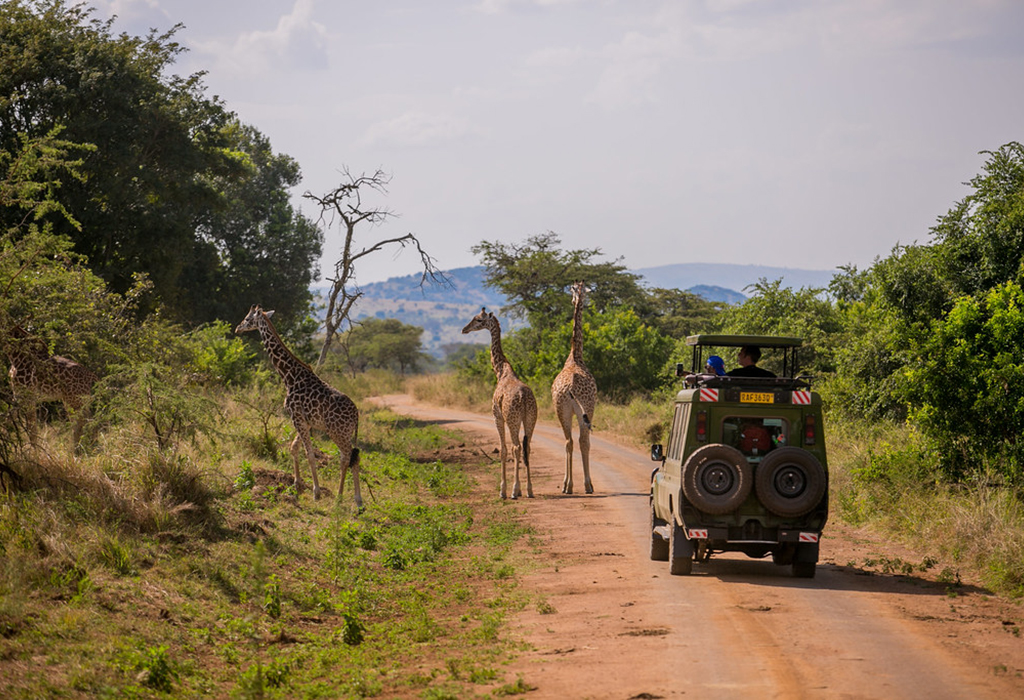
- Giraffes are easy to spot above the acacia canopy, where they feed on leaves that other animals cannot reach. They tend to be calm around vehicles, which makes them forgiving subjects for photographs.
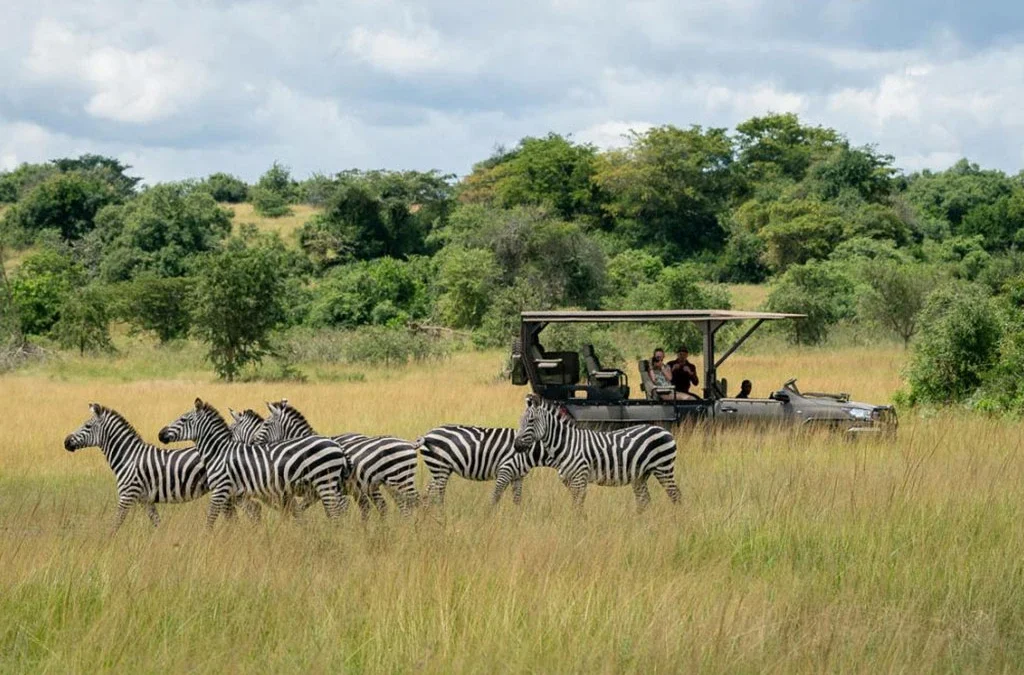
- Zebras and antelope share the open plains. Zebras graze in striped groups alongside topi, impala and waterbuck, and a keen eye may pick out the shyer bushbuck at the edge of cover.
- Buffaloes gather in large herds on the grassland, while older solitary bulls often lie up in the shade of thickets.
- Hippos and crocodiles dominate the water. Hippos spend the day submerged to stay cool and come ashore at night to graze, so the cruise is your best window into their daytime world.
- Lions hunt across the open plains and rest in shade through the hottest hours, so early morning and late afternoon give you the best odds of finding them active.
- Leopards are the park’s quiet specialists. They are mostly nocturnal, supremely camouflaged and often seen draped over a branch or slipping into long grass, which makes any sighting a memorable one.
- Rhinos are the park’s newest residents. Black rhinos are browsers that prefer thicker bush, and they are closely monitored by rangers. Seeing one is a privilege, so keep your voice low and give it space.
- Primates round out the list. Olive baboons and vervet monkeys are regular roadside characters and often provide entertainment between the bigger sightings.
Birdwatching in Akagera

Akagera’s birdlife is exceptional, with more than 480 species recorded. The mix of savannah, lake and swamp means a single day can deliver raptors, waders, kingfishers and woodland specialists.
The lakeshore is the richest area. African fish eagles perch on dead trees and call across the water, pied kingfishers hover before diving, and storks and herons work the shallows. Along the road, lilac-breasted rollers add flashes of color to the acacias. Deep in the papyrus swamps lives the papyrus gonolek, a striking red-and-black bird, and with great patience and luck a shoebill, one of Africa’s most sought-after birds, can turn up. It is a rare find, so treat it as a bonus.
Because the boat cruise gets you close to the water’s edge at a calm, unhurried speed, it is a particular treat for birders. Bring binoculars and let your guide help you identify what you see.
A Sample 2-Day Akagera Safari Itinerary from Kigali
Day 1: Kigali to Akagera and Afternoon Game Drive

Your driver-guide picks you from Kigali and heads east. After park entry formalities, you begin your first game drive. Let your guide set the pace, and give each stop a few quiet minutes, since animals are often easiest to see once the engine is off and you have settled in. Watch the tree line, scan the waterholes and notice how the landscape shifts from open plains to denser bush as you move through the park.
As the light softens toward evening, you reach your lodge. There is time to freshen up, enjoy dinner and listen to the park after dark. Hippo calls and the chorus of night insects are part of the experience.
Day 2: Morning Game Drive, Lake Ihema Boat Cruise and Return to Kigali

Breakfast comes early, because the cool first hours of the day are when many animals are most active. You head back out for a morning drive, possibly finding species you missed the day before or watching familiar ones behave differently in the soft light. With luck, this is when a lion, leopard or rhino turns up.
After lunch, you board a boat on Lake Ihema for an afternoon cruise among the hippos, crocodiles and water birds. Once you are back on shore, you begin the journey to Kigali, where your guide drops you at your chosen location in the evening.
If you have a flight the same night, let us know when you book so we can plan a comfortable buffer.
Getting from Kigali to Akagera
Akagera lies roughly 110 kilometers east of Kigali, so the road leg of your 2-day Akagera safari is short. Allow about two to three hours each way, depending on traffic leaving the city and which part of the park you are heading to. Most of the route follows good roads, and the final stretch inside the park is a gravel track, which is part of the adventure.
The drive east is a gentle introduction to rural Rwanda. The capital’s hills give way to farmland, banana groves, villages and the long, rolling ridges of the Eastern Province, and the scenery grows drier and more open as you approach the park. A morning departure makes sure you reach the park in time for the first game drive of the afternoon.
If you are arriving on an international flight, Kigali International Airport is a short drive from the city center, so an early arrival can connect smoothly with the start of the safari.
Choosing Where to Stay on your 2-Day Akagera Safari
The lodge you choose shapes the mood of your 2-day Akagera safari as much as the price does. Properties inside the park put you among the wildlife from the moment you check in. You may hear hippos grazing near your tent after dark, or find zebras at the edge of camp at dawn. Lodges and camps outside the boundary tend to be quieter and offer more space to relax, with a short drive to the gate in the morning.
Tented camps feel closer to the bush, with canvas walls, lantern-lit paths and the sounds of the night all around. Standard lodges offer a more conventional hotel-style comfort with solid rooms, restaurants and views over the plains or lake. Either suits a short safari well.
When we prepare your quotation, we will ask what matters most to you. If you want sunset drinks with a view, say so. If your priority is the shortest route to the lake for the cruise, we will look at properties with that in mind. A good lodge choice makes the two days feel unhurried.
Photography Tips for Your 2-Day Akagera Safari
Two days is not much time, so a few habits help you leave with good pictures.
Use the vehicle as a hide. Animals accept a parked vehicle far more readily than a person on foot, so ask your guide to switch off the engine and wait. Early morning and late afternoon give the warmest light, while the midday sun flattens everything, so use it for rest or lunch.
A lens in the 200 to 400 millimeter range suits most wildlife, but a modern smartphone with a telephoto camera can capture beautiful images of larger animals and landscapes. Photograph birds and hippos at eye level rather than from above when you can, since lower angles feel more intimate.
On the boat, use a faster shutter speed to freeze movement and keep a lens cloth handy for spray. Back on land, dust can be a problem, so keep your gear in a bag between stops. Carry a spare battery and memory card, as you will take more pictures than you expect. Above all, never use flash near animals.
Who this 2-Day Akagera Safari Suits
A 2-day Akagera safari fits several kinds of traveler well. Couples looking for a romantic night in the bush will appreciate the calm evenings and the lake cruise. Friends traveling together can share the vehicle and enjoy the camaraderie of a short adventure. First-time safari-goers get a gentle introduction to wildlife viewing without the commitment of a long trip.
It is also ideal for business travelers and those in transit. If you have a spare couple of days around meetings or a long layover in Kigali, the park is close enough to fit in comfortably. Keen birdwatchers will find the lake and wetlands rewarding, and anyone who simply wants a break from the city will come back refreshed.
Is a 2-Day Akagera Safari Worth It?
For many travelers, yes. A 2-day Akagera safari delivers the essentials of a safari, including the wildlife, the landscape, a lake cruise and a night away, without the time or cost of a longer expedition. Everything is bundled into one booking, so there are no separate arrangements to juggle between park, driver, boat and lodge.
It works best as an introduction to Akagera. If your priorities are extended photography sessions, multiple specialist activities or a slow, unhurried pace, a longer stay will serve you better, and we can build one.
The Best Time to Visit Akagera
A 2-day Akagera safari works in any month, as the park is open year-round and each season has its own character. Rwanda has two dry seasons and two rainy ones.
- The long dry season runs from roughly June to September, and a shorter dry spell follows around December to February. During these months, grass thins out and animals gather near water, which often makes them easier to find. The landscape turns golden and dusty, and these are also the busiest periods for travel.
- The long rains fall roughly from March to May, with a shorter rainy season in October and November. The park turns deep green and the skies can be dramatic, which photographers tend to love. Roads may be muddier and plans occasionally need flexibility, which is why a suitable vehicle and an experienced guide matter.
Neither season guarantees particular sightings. Choose the one that fits your wider trip and the scenery you prefer.
Health, Safety and Comfort
Akagera is a well-managed park, and a few simple precautions keep your 2-day Akagera safari comfortable.
The equatorial sun is strong even on cloudy days, so wear a hat and sunscreen and drink plenty of water throughout the safari. Insect repellent is wise, particularly around the lake and in the evening. Tsetse flies are present in parts of the park, and they are attracted to dark colors such as black and navy, so light or neutral clothing is more comfortable.
Rwanda has banned single-use plastic bags, so leave them at home. Your luggage may be checked on arrival in the country, and carrying a reusable bag instead is easy.
Roads inside the park are mostly dirt tracks, so expect some bumps and dust. If you are prone to motion sickness, mention it to your guide, who can adjust the pace.
Traveling Responsibly in Akagera
Tourism is part of what pays for Akagera’s recovery, so how you travel matters. Choose experiences that respect the park’s rules and its people. Buy crafts and snacks from local sellers where possible, so your spending reaches nearby communities. Bring a refillable bottle rather than relying on disposable ones, and carry out whatever you bring in.
The most important contribution is simple: treat the park as the animals’ home. Give wildlife space, resist the urge to chase a better angle, and trust your guide’s judgment about when to move on. A sighting you wait for patiently is almost always better than one you force.
Preparing for Your 2-Day Akagera Safari
Pack:
- Comfortable, lightweight clothing
- A warm layer for early mornings
- A hat, sunglasses and sunscreen
- Comfortable closed shoes
- Binoculars and a camera
- Your passport and any prescription medication
- A reusable water bottle
In the park:
- Follow your guide’s instructions and stay in the vehicle where asked.
- Keep a respectful distance and never feed animals.
- Speak quietly and move slowly.
- Take all litter with you.
Make the Most of Your Time in Kigali
Because the safari starts and ends in the capital, it is worth spending a day or two there. The Kigali Genocide Memorial is a deeply moving and important place to understand Rwanda’s history and its remarkable recovery. For a lighter side, wander the Kimironko Market for fabrics, fruit and crafts, visit the Inema Arts Center to see contemporary Rwandan art, or spend an afternoon in a hillside café sampling the country’s famous coffee.
Kigali is known for being clean, safe and easy to navigate, and many travelers find it a relaxing counterpoint to the bush. Planning a day before the safari lets you adjust to the time zone, while a day after gives you a comfortable bed and a hot meal.
Rwandan Culture and Etiquette
A little cultural awareness goes a long way in Rwanda. Greetings matter, and a friendly “Muraho” (hello) is warmly received in villages and lodges alike. Rwandans are generally reserved and polite, so speak gently and smile.
Ask permission before photographing people, especially children, and dress modestly when you are in towns and villages. Public displays of impatience are frowned upon, so a calm, courteous manner works best.
One local rhythm is worth knowing about. On the last Saturday of every month, Rwandans take part in Umuganda, a national community service morning. Roads can be quieter, shops may open late and non-essential movement is restricted until late morning. If your departure falls on that day, tell us so we can plan your pickup around it.
Extending Your Trip Beyond Two Days
Many travelers treat a 2-day Akagera safari as the first chapter of a longer Rwanda journey. The most popular add-on is gorilla trekking in Volcanoes National Park, in the north, which pairs naturally with a savannah safari. Nyungwe Forest offers chimpanzee tracking and a canopy walk, and Lake Kivu on the western border is a restful place to end a trip, with beaches, boat rides and lakeside lodges.
Each destination is several hours from Kigali, so the order matters. A common plan is to finish the Akagera safari, return to Kigali, and then head to the mountains or the forest. Gorilla permits are arranged separately and add to the budget, so tell us the full shape of your trip and we will plan the order, driving times and nights.
Ready to Book Your 2-Day Akagera Safari with Iconic Africa Safaris?
Iconic Africa Safaris offers three simple, reliable ways to secure your next unforgettable Akagera adventure today. Simply complete our quick online booking form to start planning your dream safari experience right away. Our friendly team also welcomes direct emails at info@iconicafricasafaris.com to discuss your specific travel plans and preferences. For WhatsApp messages and calls, tap the green WhatsApp icon in your screen’s bottom right corner anytime.
Your experience on the ground matters just as much as your itinerary. Our experienced driver guides understand Uganda’s wildlife and cultural heritage and help you appreciate the places you explore. They accompany you throughout your safari, from the initial pickup to your final drop off, coordinating daily travel and activities while sharing local knowledge that adds depth to every destination. With thoughtful planning and personal guidance, your safari becomes more than a holiday; it becomes a collection of lasting memories.
Frequently Asked Questions About the 2-Day Akagera Safari
How much does a 2-day Akagera safari cost?
Prices start from $780 per person sharing, which covers park fees, transport, your driver-guide, game drives, the Lake Ihema boat cruise, meals and one night’s accommodation. Your final quotation states the exact total for your group and depends on your travel dates, room arrangements and the lodge you choose. Send us your details and we will confirm the figure before you commit to anything.
Is the boat cruise on Lake Ihema included?
Yes, the cruise is part of the package and needs no extra payment. It takes place on the afternoon of Day 2, once your morning game drive and lunch are done. This timing means you finish the safari on the water, watching hippos, crocodiles and birds, before heading back to Kigali. If the cruise matters especially to you, mention it when you inquire so we can plan the day around it.
Will I see the Big Five in two days?
Akagera is home to all five species, and its conservation recovery is remarkable, but wildlife roams freely and sightings can never be promised. Leopards are the hardest to find, while elephants and buffaloes are usually easier. Two days of game drives give you real chances, and your guide will use experience and local knowledge to make the most of the time and the conditions.
Is a 2-day Akagera safari long enough?
For a first look at the park, yes. You get game drives on two separate days, a night close to the wildlife and a cruise on the lake, which is a fuller experience than a single day trip. Travelers who want slower exploration, more photography time or extra activities can ask us about longer itineraries, and we will build one around their interests.
Can solo travelers book a 2-day Akagera safari?
Yes, solo travelers are welcome. Because the room cost is not shared with another guest, a single-room supplement applies, so the per-person price will be higher than the sharing rate. The exact figure depends on your dates and the lodge. Send us your plans and we will price it precisely, so you know the full amount before making any decision about the booking.
Can families with children join?
Yes, families are welcome. Please share each child’s age when you inquire, since park fees and the most comfortable pace for the trip can vary with age. We can suggest lodges with suitable room arrangements and plan breaks into the game drives, so younger travelers stay comfortable and engaged. Tell us what your children enjoy most, whether it is animals, birds or boats, and we will plan around it.
How early should I book?
Book several weeks ahead for dry-season and holiday dates, or whenever you have a favorite lodge in mind, since the best rooms are taken first. Shorter notice can still work during quieter months, though your choice of accommodation may be narrower. If your dates are fixed, contacting us early gives you the widest choice and the calmest planning.
Can I add a night game drive?
Yes, on request. A night drive is charged separately and has to fit around your lodge location and the next day’s schedule, so it is best to ask when you first inquire. After dark, the park feels completely different, and you can meet nocturnal animals that daytime visitors rarely see. We will confirm the price and timing in your quotation.
Can you cater for dietary requirements?
Yes, with notice. Tell us about any allergies, intolerances or preferences when you book, whether you are vegetarian, vegan, gluten-free or avoiding particular foods, so the lodge kitchen can prepare in advance. Advance notice matters in a remote setting, where ingredients are not always available at short notice. We will pass your requirements to the lodge and confirm they have been noted.
Do I need malaria tablets or vaccinations?
Akagera is in a malaria-risk area, so speak to your doctor or a travel clinic well before departure about preventive medication that suits your health and medical history. Yellow fever documentation may be required depending on the countries you travel from, and routine vaccinations should be up to date. Authorities and clinics can change their advice, so check the latest guidance before you travel.
Is Akagera safe for visitors?
Yes. Rwanda is widely regarded as one of Africa’s safest countries, and Akagera is professionally managed with active ranger patrols. Your guide will brief you on staying inside the vehicle where required and keeping a respectful distance from wildlife, which are the main safety rules in the park. Follow those instructions and you can relax and enjoy the experience.
What happens if it rains during my safari?
Game drives usually continue in light rain, and the park often looks beautiful afterwards, with fresh green grass and clear air. If heavy weather affects the roads or conditions on the lake, your guide will adjust the timing or route to keep you safe and comfortable. A waterproof layer and a flexible attitude are the best preparation for changing weather.
Is tipping expected?
Tipping is customary but entirely at your discretion. Many travelers tip their driver-guide and lodge staff when they are happy with the service, and it is usually given in cash at the end of the trip. There is no fixed amount, so give what feels fair for the quality of the experience. Plan to carry a little cash for this purpose.
Is the safari suitable for travelers with limited mobility?
Often, yes. Most of your time is spent in the vehicle or on the boat, and the pace is relaxed, with no long walks required. Vehicle access, steps and lodge layouts vary, so tell us about any needs when you inquire. We can then suggest suitable accommodation, plan easier boarding for the cruise and make sure the trip works comfortably for everyone.
Can I bring a drone?
Drones are tightly regulated in Rwanda and are generally not allowed in national parks without authorization. Flying one without permission can lead to confiscation and fines, and the noise disturbs wildlife and other visitors. Please ask us before packing one, and we will tell you whether any permission is possible. For most travelers, a good camera and binoculars capture the safari far better.